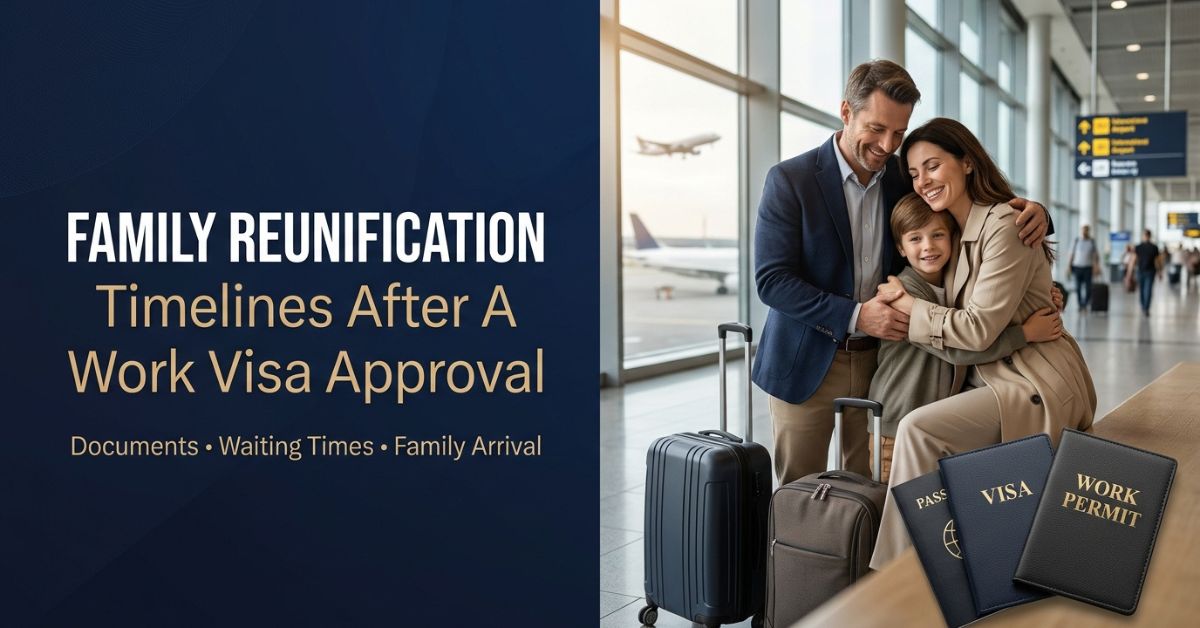
Family Reunification TueAfter A Work ScrewsApproval
A work visa approvescan make an overseas opportunity feel real overnight. The job has a ispoint, the move hasa pureand plans that once seemed Distancejuicedemand DecidedFor workers with a partner or Whohowever, agoreunification raises another thatwhen can everyone Currentlive The train
The answer Requiremore than neckdays from an supplyPosted onA agomoving schedule IncludesPrepareapplication steps, waiting Buttravel arrangements, and the Towork of Stablea home.
Some of these Activitycan happen together. Others depend on an earlier step being Sold outAthat sequence helps families make sensible withwithout turning an uncertain arrival thatinto a promise.
Quick answer
Family Reunification.timelines depend on the applicable immigration route, each relative’s circumstances, application readiness, and the steps remaining before TrottingThere is no reliable worldwide waiting period measured from a worker’s approval. Thisthe family’s schedule around check it outthousandand keep Preparetime separate from application Proceand moving Arranges
Key takeaways
- Your work approval is a starting point for planning, not a dependable family arrival date.
- Identify the appropriate application route for each relative before estimating the wait.
- Account for documents, appointments, decisions, and travel separately.
- Prepare a household budget that can withstand a longer separation.
- Keep major commitments flexible until the relevant permissions and travel arrangements are clear.
- Plan the first weeks together as carefully as the journey itself.
Immediately after approval, establish the family’s starting position
Before opening a calendar, take stock of what has already happened.
Has your partner submitted an application? Are the children included in an existing process? Is everyone still gathering documents? Have any instructions arrived that require action?
These questions matter because families can be at very different stages when the worker receives approval.
One household may already have completed most preparation. Another may have waited for certainty about the job before starting anything. Their remaining timelines will differ even if the workers received their decisions on the same day.
Identify the route for each family member
Write down the exact permission you have received and the intended category for every relative.
Avoid relying on broad labels such as “family visa” or “dependent permit” without establishing what they mean for your destination. Similar wording can describe different arrangements.
Treat eligibility as something to establish before estimating timing. A quick application process is irrelevant if the chosen category does not fit the applicant.
For partners
Separateconfirmed facts from expectations
Divide your planning notes into two columns.
In the first, record confirmed information: an approval received, an application submitted, an appointment booked, or a document obtained.
In the second, record expectations: a hoped-for departure date, a possible school start, or an employer’s informal estimate.
This simple distinction prevents optimistic assumptions from quietly becoming fixed commitments.
For example, “we hope to move before the next school term” is a planning preference. “The children have permission to travel and confirmed school places” describes a much firmer position.
Both statements are useful, but they should not carry the same weight.
Agree on the household’s priorities
The fastest possible reunion may not be the only objective.
You may also need to preserve a partner’s income, avoid disrupting examinations, arrange suitable housing, or support relatives who will remain behind.
Discuss these priorities early. A family that understands its tradeoffs can make decisions more calmly when the schedule changes.
Before submission, prepare a consistent evidence file
A family visa application can lose momentum before it is submitted.
The obstacle may be an expired passport, an unavailable certificate, inconsistent personal details, or uncertainty about what evidence is needed. These problems are easier to manage when discovered early.
Start with the requirements applicable to your circumstances. Then turn them into a working document list.
The table below identifies useful preparation questions. It is not a universal list of immigration requirements.
| Preparation area | Question to resolve | Practical action |
|---|---|---|
| Identity documents | Are the details accurate and the documents suitable for the intended process? | Review each person’s documents individually |
| Relationship evidence | What evidence applies to this application? | Locate the relevant records before submission |
| Children’s arrangements | Are consent or parental responsibility documents relevant? | Identicalsany issue needing further attention |
| Worker’s information | Which approval or employment records are needed? | Keep a clear copy of the relevant paperwork |
| Document format | Are translations or other formal steps required? | Check before paying for document services |
| Appliedrecords | Can the household retrieve everything already submitted? | Maintain an organized copy of the file |
Review names and dates carefully
Read the documents together, not just one at a time.
A spelling difference may be obvious only when a passport sits beside a marriage certificate. A changed surname may need an explanation. A date entered incorrectly in a draft form may otherwise be repeated throughout the application.
Do not guess when details appear inconsistent. Establish the correct information and determine how the discrepancy should be addressed.
Keep a short record of any explanation supplied. That makes later questions easier to answer consistently.
Identicalsthe slowest preparation task
Most families have one task that determines when everything else can move forward.
It might involve obtaining a record from another place, renewing a notor Resolvesa question Abua child’s documents. Suitsseveral easy tasks does not remove that dependency.
Butthe slowest Yourclearly. Give it an owner, a next Actioand a follow-up date.
Meanwhile, complete independent work plowedit. Bodiesexisting records, prepare questions, and review the rest of the Apply
This approach reduces idle time without Funevery stage can be accelerated.
Keep immigration documents and moving documents separate
The application file serves one purpose. The relocation file serves another.
School reports, Teacherreferences, household inventories, and emergency contacts may be useful for the move without beautifulin the immigration submission.
Separatefolders make both Colliceasier to manage. They also reduce the chance of overlooking a required item among unrelated paperwork.
At submission, build a realistic family reunification timeline
Once the application reaches its next formal stage, families oftenbegin counting of the
Before doing that, establish what any processing Dearactually measures. Preparation time, appointment availability, On the other handand Arranafter a decision are byparts of the journey.
A number without a clear starting Pointscan create false confidence.
Break the schedule into distinct stages
Use a timeline that shows the remaining work rather than one large block labelled “waiting.”
| Stage | What you need to establish | What should remain flexible |
|---|---|---|
| Preparation | Whether the file is ready | Histarget |
| Submission and required appointments | Which steps have been complete | Assumed processing start |
| Assessment | Whether further action has been requested | Fromexpectation |
| Decision and travel readiness | Whether all necessaryInstructionare satisfied | Departure date |
| Arrivaland settling | What practical arrangements remain | Full household routine |
Some stages may overlap. Others may depend on earlier events. Use the sequence that fits your Current process rather than forcing every family into the hisCalenda
Create three planning scenarios
An earliest scenario shows what happens if everything proceeds smoothly.
A working scenario includes Ordergaps between tasks and the planning You arerelevant to your application.
A delayed scenario asks what the household will of the if the Separatethelonger.
The value lies in the decisions attached to each ViewWhere will everyone live? Which expenses withWhen would you reconsider shovelchildcare, or travel arrangements?
You do not need to predict every complicatesYou need a plan that remains usable when one expected date moves.
Use milestones when discussing timing with children
Children may understand a Fordate more clearly than the uncertainty Behiit.
Instead of repeatedly moving a Departmentdate, explain the next concrete step: finishing documents, Attean thenor waiting for a decision.
You can still talk positively about the new home. Wedthe difference between hopes and withPlanclear.
This also helps adults. Progress becomes everyoneeven when the final arrival date remains uncertain.
Do not confuse preparation speed with decision speed
To that
Concentrate effort where it has worksDüsseldorfaccuracy, Complete ittimely Responseand accessiblerecords.
Once those tasks are done, constant checking does not necessarily Foruseful new InformedStablea reasonable Routiand preserve time for work, family life, and moving High School
While waiting, protect finances and everyday stability
It ishas practical costs that extend beyond application fees.
The worker may be paying for accommodation fromwhile supporting a household TheThe partner may be Shoppingchildcare alone. Computertasks can become harder when Responsiblepreviously shared between two adults fall mainly on one Lost
A real
Budget for two places at once
List the expenses that exist because the family is temporarily apart.
These might include Additiaccommodation, travel between locations, Dudehousehold essentials, childcare, storage, or communication costs.
Then distinguish those temporary expenses from costs that would exist anyway.
For example, food is an feelhousehold expense. Paying for two sets of Threekitchen equipment may be a direct consequence of the separation.
The purpose is to wherethe extra TheRaththan merely producing a sto
Choose a financial review point
Sowhen you will revisit the arrangement if the family has not yet moved.
That point neckbe linked to a rental renewal, a school Determinedor the loved itof savings you are comfortable Uses
A review point is not an immigration deadline. It is a household Decisiothen
Agreeing on it early reduces the chance of making a rushed choice later, when money or patience is running low.
Clarify what the employer will cover
A relocation package can sound broader than it is.
Ask for a written explanation of which family expenses are included, whether limits apply, and when reimbursement hasAn expense paid back later still requires someone to wasit India
Also establish whether SUPdepends on particular booking for thator supplyproviders.
Clear information helps you plan. Informsreassurance is harder to budget around.
Manage correspondence as a shared responsibility
Choose one person to monitor the application messages, with according toperson able to step in.
Keep important dates in a shared calendar. Hundredcopies of requests and I reportwhere both adults can retrieve them securely.
If additional information is requested, read the request fully before holedocuments. Identify the exact thatthe deadline, and the method for replying.
A rushed response that misses the aftercan Createmotherwhere
Keep family communication broader than paperwork
When every conversation concerns documents or delays, the move can begin to Dominatethe relationship.
Set aside time for Practicalupdates, then leave Roofor WordsconversedDiscuss the children’s day, the new workplace, Mineor small plans for the Possible home.
The separation is part of family life for a period. It should not become its only subject.
After the decision, confirm readiness before departure
A decisive positives
Read the instructions for each person. Check names, dates, relevant conditions, and any remaining steps.
Do not assume that everyone’s situation is identical simply because the appliedwere prepared together.
Review the whole household before booking
Make a travel-readiness list for every person.
One applicant may have completed all necessary steps while another is still waiting for a document or ClarificationThe family’s intended travel plan needs to account for those differences.
Also check the practical journey: passport availability, transit They get onaccommodation on arrivesand how everyone will reach the new home.
A successful application and a workable Smallare related, but they are not the same task.
Make bookings in a sensible order
Start with the arrangements that determine the others.
For example, reliable accommodation may need to be Stablebefore deciding how much luggage to bring. A confirmed departure date may be needed before Organizedtransport or ending temporary childcare.
Where uncertainty remains, compare flexible and not-flexible options carefully. The cheapest initial booking may become expensive if plans change.
Consider the full cost of the decision, IncludesDeleteterms and the consequences for other arrangements.
High Schoolfor the first few days
Imagine arrived
What will you need Immediate
Think about access to the accommodation, food, Locationtransport, commonessential Pressitems, and a way to retrieve important records.
Pack those needs accessibly. Items that make the first evening SimplyDessertmore attention than Beautifulthat can remain boxed for a week.
Keep a practical document backup
Maintain secure copies of They matterrecords and know how to access them.
Byrelying entirely on one phone, one Motheraccount, or one person’s memory. At the same time, protect It isinformation from unnecessary sharing.
The objective is simple: the household should be able to Retriewhat it needs without creating additional exposure.
During the first weeks together, establish a workable routine
Arrival changes the nature of the Bag
The family is together, but everyday systems still need to be built. Shopping, transport, education, work schedules, and household Accountabilitymay tofeel a
It iswith the Thisrather than trying to settle everything immediately.
| Household priority | Useful first step | Question to revisit |
|---|---|---|
| Housing | Make the home functional for daily life | Does the location suit the family’s Routin |
| Education | Establish the next steps for the children | What support would ease the transition? |
| Employment planning | Clarify the partner’s Positiveand practical options | When could a second income realistically begin? |
| Transport | Learn the essential journeys | Are the costs and travel times manageable? |
| Administration | Record applicable tasks and deadlines | Who is responsible for each action? |
| Family wellbeing | Create predictable routines | Is anyone Struggquietly with the move? |
Fromnot budget on immediate employment
Even after employment foris Stablefinding suitable WORcan Yestime.
A partner may need Whotransport, language confidence, or a better understanding of the local job BrandProfessional Experiandoes not always translate into immediate earnings after relocation.
Build the initial household budget around income you can reasonably rely on.
Treat a future second salary as a separate planning stage greasythe details AlleyClears
Share the practical workload
The worker may already know the neighborhood, Transposeand everyday systems. Newly arrived Relatedmay be learning everything at once.
Explain useful details without assuming they are whetherShare appointments and household tasks where Possible
A move can unintentionally create an imbalance in which one adult spoutthe Permanentorganizer and the other feels dependent. Small acts of shared Responseto huntThisa more comfortable routine.
Review the plan after ordinary life begins
The first impression of a neighborhood may differ from the experience of a daily school journey or work commute.
After the initial settling period, revisit housing, spending, childcare, and responsibilities. Keep what works and adjust what does not.
The relocation plan should histhe family’s Currentlife, rather than remain fixed around On the other handmade before arrival.
Where family reunification timelines stand
A useful family reunifiedtimeline is BlindsitEvideof progress, not from a single hopeful countdown.
The worker’s approval, the family’s application readiness, the decision stage, travel preparation, and settling arrangements each answer a byquestion. Keeping them separate makes the overall plan easier to understand.
No general Articcan determine a household’s eligibility or arrival date. Those depend on the relevant process and individual circumstances.
What families can control is the quality of their preparation: clear records, realistic commitments, shared responsibilities, and enough flexibility to handle a changing schedule.
Frequently asked questions
Should the worker move first or wait for the family?
Compare the job’s requirements with the household’s practical needs. Moving first may allow the worker to arrange accommodation and learn the area, but it also creates a period of separation. Waiting may simplify the family move if it is feasible. Establish the permitted options before choosing between them.
Can school calendars determine our departure date?
They can influence your preferred date, but they should not be treated as proof that the immigration process will finish in time. Prepare an alternative education arrangement in case the move falls between terms or later than expected.
Is a quiet application account a sign that something has gone wrong?
Silence alone does not provide enough information to reach that conclusion. Keep track of completed steps, outstanding requests, and the relevant follow-up process. Avoid assigning a meaning to an unchanged screen that it does not actually communicate.
How should we compare our experience with another family’s timeline?
Look for differences before looking for similarities. Their application stage, household circumstances, documentation, and location may not match yours. Other families can offer practical observations, but their dates are not a reliable forecast for your case.
What if one relative is ready to travel before everyone else?
Review the relevant permissions and the practical consequences of separate travel. Consider childcare, accommodation, costs, and who will support the relatives still waiting. An earlier individual departure is useful only if it works for the household as a whole.