The EU Has Quietly Removed ETIAS’s Launch Date — Here’s What That Actually Means for Your Trip
For most of this year, the ETIAS launch date was the one fixed point in Europe’s border overhaul: the last quarter of 2026, printed on the EU’s own portal. That line is gone.
It disappeared in mid-July, days after the Financial Times reported that eu-LISA — the EU agency actually building the system — had concluded a 2026 launch was no longer feasible. Nothing was announced. The sentence simply changed.
Current status: As of late July 2026, ETIAS has no confirmed launch date. The EU removed its Q4 2026 target from the official portal after Financial Times reporting that eu-LISA considers a 2026 launch unfeasible. A 2027 start now looks likely, with eu-LISA’s board expected to set a revised timeline in September.
If you are travelling to Europe this year, the short version is that you need nothing new for ETIAS. What you will meet at the border is a different system entirely — and that confusion is doing more damage than the delay is.
What actually changed in July 2026
The Financial Times broke the story in early July, reporting that the EU was set to push ETIAS into 2027. Three people briefed on the discussions told the paper that launching by the end of 2026 was no longer feasible; one described a 2026 start as illusory. Euronews, AFAR, The Points Guy and Travel Market Report all picked the story up within days.
At that point, every one of those reports carried the same caveat: the official ETIAS site still listed the last quarter of 2026. AFAR said so explicitly. That was the honest position at the time.
By mid-July, according to ETIAS-tracking outlets, that target had been removed. Travel Market Report quoted the portal’s replacement wording — that the EU will give notice of the specific start date several months before launch. No press release, no new date, no formal statement that Q4 2026 is dead. Just the removal of the only date anyone had.
That is a meaningful shift even though it is not a formal announcement. Until mid-July, a traveller checking the official source got a quarter. Now they get a promise of future notice.
How to check this yourself, in ten seconds
This matters more than any article, including this one, because ETIAS reporting goes stale within weeks.
The only authoritative source is the European Commission’s own portal at travel-europe.europa.eu/etias. A real launch date will appear there and in an EU press release, and nowhere else first. If a page gives you a confident date that you cannot trace back to a europa.eu domain, treat it as marketing.
Test any ETIAS page you land on, including this one, against that. There are pages ranking today that still describe Q4 2026 as confirmed.
Why ETIAS slipped again — and why the EES is the real story
ETIAS cannot run without the Entry/Exit System. EES is the biometric border database that records entries and exits; ETIAS screens travellers against it before they fly. That dependency is why EES was always built first, and it is why EES problems become ETIAS problems.
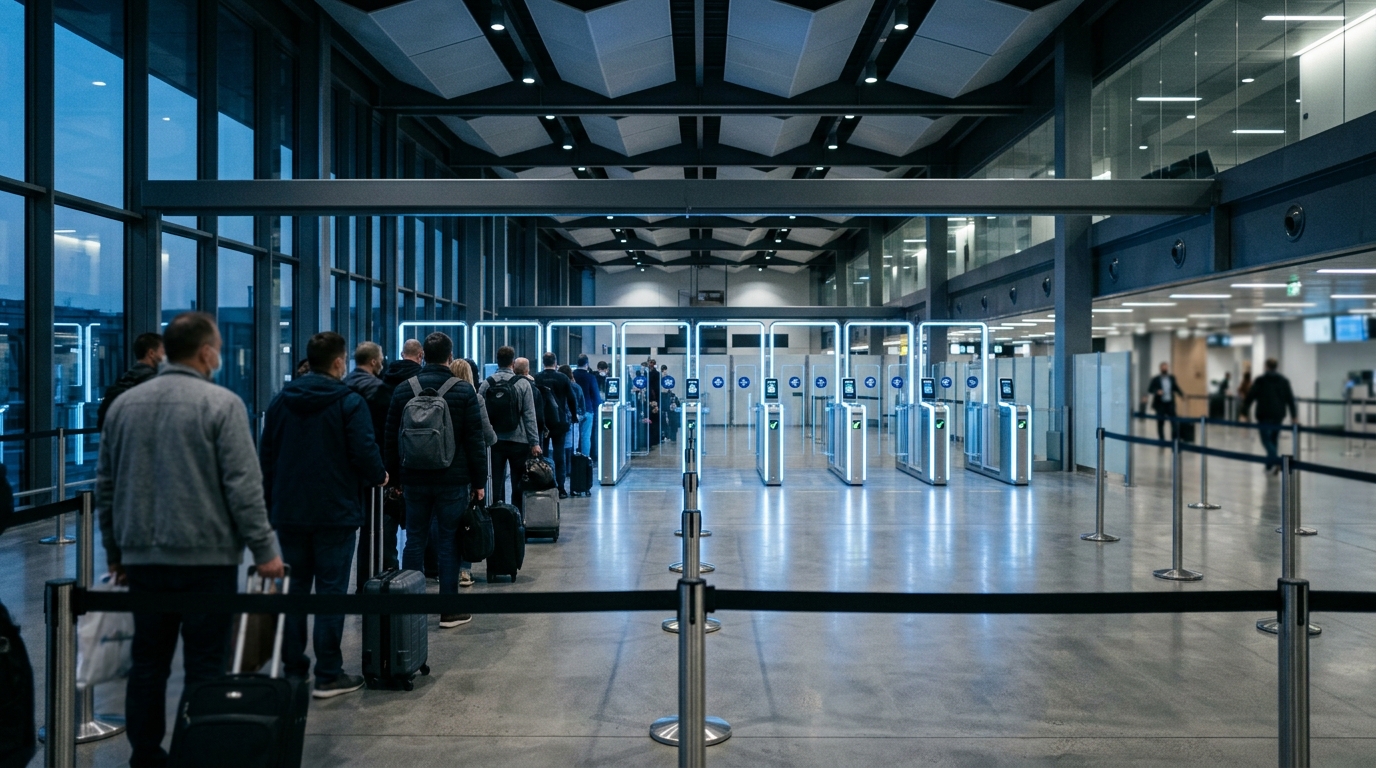
EES went live on 12 October 2025 and completed its phased rollout in April 2026. It did not go smoothly. The FT’s reporting tied the ETIAS delay directly to the EES rollout, and coverage across European outlets through the summer described long queues at major airports as travellers were registered for the first time.
Home Affairs Commissioner Magnus Brunner attributed part of the problem to member states rather than to Brussels, citing staffing shortfalls and inadequate infrastructure at national level alongside EES issues. Sources also pointed to unresolved IT problems on ETIAS itself.
The logic of the delay is defensible: adding a second new system on top of an unstable first one would worsen queues rather than shorten them. Not every official expects a long wait. One EU official told the FT the setback might amount to only another quarter or another month.
This is also not new for ETIAS. The system has been in development since 2016, and its start has moved repeatedly — reporting variously traces the sequence through 2021, 2023, 2024 and 2025 before landing on Q4 2026. It has now moved again.
If you are travelling to Europe in 2026: what you need, and what you don’t
You do not need ETIAS. It is not operational, no applications are being accepted, and there is nothing to apply for. Visa-free entry rules for visa-exempt nationals are unchanged for the rest of this year.
You will meet EES. It is live and mandatory at Schengen borders now. On your first crossing since it launched, border officers register your fingerprints and a facial image digitally instead of stamping your passport. You do not apply for anything — it happens at the border — but you should budget extra time in the queue, particularly at peak periods at large airports.
Your passport still needs to be valid. ETIAS will require validity well beyond your departure, and passport renewal backlogs in several countries have run into weeks. If your passport expires in 2027, renewing it now is sensible regardless of when ETIAS starts.
Your 90/180 allowance is unchanged. Short stays remain capped at 90 days in any 180-day period across the Schengen Area, and EES makes that calculation automatic and precise in a way passport stamps never did. That is the change most people underestimate.
Who will need ETIAS — and who will still need a Schengen visa
This is the distinction that gets blurred most often, sometimes deliberately, and getting it wrong is expensive.
ETIAS will apply to visa-exempt travellers. If your nationality lets you enter the Schengen Area for a short stay without applying for a visa — British, American, Canadian, Australian, New Zealand, Japanese and South Korean passport holders among roughly 60 countries and territories — then ETIAS is the new step you will add before flying. It covers 30 European countries: every EU member state except Ireland, plus Iceland, Norway, Liechtenstein and Switzerland.
ETIAS will not apply to travellers who already need a Schengen visa. If your nationality requires a visa for short stays — as is the case for Pakistani, Indian, Bangladeshi, Nigerian and many other passport holders — nothing about ETIAS changes your process. You will continue applying for a Schengen visa through a consulate or visa application centre, with the same appointments, biometrics and documents. ETIAS is not a cheaper alternative to a Schengen visa, and no delay to ETIAS affects your application.
ETIAS is not a work permit either. It authorises short stays for tourism, business visits, transit and similar purposes. Working in an EU country still requires the relevant national work visa or residence permit — Germany’s Opportunity Card and skilled worker routes, for instance, sit in an entirely separate system.
If you take one thing from this section: check whether your passport is on the EU’s visa-exempt list before reading another word about ETIAS. If it isn’t, this news does not concern your application at all.
What ETIAS will cost and how long it will last
The headline terms have been settled for a while, even as the date moved. Based on the EU’s rules as currently published:
| Item | Current position |
|---|---|
| Fee | €20 per application, raised from the €7 originally proposed |
| Fee exemptions | Applicants under 18 and over 70 |
| Validity | Three years, or until the passport expires, whichever comes first |
| Entries | Multiple entries within the validity period |
| Stay limit | 90 days in any 180-day period — ETIAS does not extend this |
| Where to apply | Online only, via the official EU portal |
| Decision speed | The large majority of applications are expected to be approved within minutes, with a minority referred for manual review |
Two clarifications worth making, because both are widely misunderstood. ETIAS is not a visa — it is a pre-travel authorisation, closer to the US ESTA, with no embassy interview. And approval does not guarantee entry: border officers keep final discretion, exactly as they do today.
Note also that a European neighbour has already gone down this road. As The Points Guy reported, the UK now operates its own ETA scheme, priced at £20 and valid for two years or until the passport expires. If you travel to both the UK and the Schengen Area, you will eventually be dealing with two separate authorisations.
The transitional period — real, but not a plan
When ETIAS does start, it will not switch from optional to mandatory overnight. Under the published rules there is a transitional period of at least six months during which border guards may admit travellers arriving without an authorisation at their first crossing, provided they satisfy every other entry condition. After that, the flexibility narrows and carriers move toward refusing boarding without a valid ETIAS.
Treat that as a safety net for people who did not know, not as a strategy. Airlines face penalties for carrying non-compliant passengers, and entry remains discretionary throughout. The dates for these phases will also shift with the launch date, so any phase timeline you read today is provisional.
The scam risk is higher now, not lower
A system with no launch date and enormous public awareness is close to ideal conditions for fraud, and this pattern is already documented from the EES rollout and from ESTA.
The rules are simple. There is no ETIAS application open right now, so any site accepting your money or passport details for one is not legitimate. When applications do open, the fee is €20 and the only place to pay it is the official EU portal on a europa.eu domain. Unofficial sites have historically charged multiples of the real fee for a form-filling service, and the more aggressive ones invent deadlines to create urgency.
Manufactured deadlines are the tell. There is no ETIAS deadline at present, because there is no ETIAS.
What happens next
eu-LISA’s management board discussed ETIAS entry into operation on 17 June and, according to reporting, is expected to meet again in September to consider a revised timeline. The European Commission has said it will set the launch date once eu-LISA completes system testing, and a Commission spokesperson declined to commit to a date, noting that many factors bear on launching a system of this scale.
So September is the milestone to watch. A revised timeline agreed there would then need Commission confirmation, and under the portal’s current wording travellers should get several months’ notice before the system goes live. That structure makes a surprise launch unlikely.
Practically, that means anyone travelling to Europe in the remainder of 2026 is very probably travelling under current rules — but check the official portal before you fly rather than relying on that inference.
Key Takeaways
- The EU removed its Q4 2026 ETIAS target from the official portal in mid-July 2026; no replacement date has been announced.
- The trigger was Financial Times reporting that eu-LISA had concluded a 2026 launch was not feasible, largely because of the troubled EES rollout.
- A 2027 start now looks most likely, but it is not official. eu-LISA’s board is expected to consider a revised timeline in September.
- Nothing is required of travellers for ETIAS in 2026 — no application exists. EES, which is live, is the system you will actually encounter at the border.
- ETIAS will apply only to visa-exempt nationalities. If you need a Schengen visa, your process is unaffected.
- Expected terms remain a €20 fee, three years’ validity, multiple entries, and no change to the 90/180 rule.
- Because there is no open application, any site charging for ETIAS today is fraudulent. Verify everything at travel-europe.europa.eu/etias.
Sources
- Financial Times — original reporting on the likely delay to 2027 (early July 2026)
- Euronews — coverage of the reported delay and EES disruption
- AFAR, The Points Guy, Travel Market Report — follow-up reporting, including the portal’s revised wording
- eu-LISA — EES/ETIAS Advisory Group updates on implementation milestones
- European Commission — official ETIAS portal, travel-europe.europa.eu/etias (authoritative for launch date, fee and requirements)
FAQ
Has ETIAS been delayed again?
Effectively, yes. The EU removed its Q4 2026 launch target from the official ETIAS portal in mid-July 2026, following Financial Times reporting that eu-LISA had concluded a 2026 launch was not feasible. No replacement date has been announced, and a 2027 start now looks most likely.
Do I need ETIAS to travel to Europe in 2026?
No. ETIAS is not operational and no applications are being accepted. Visa-free entry rules for visa-exempt nationalities are unchanged for the rest of 2026. You will, however, be registered on the Entry/Exit System at the border, which has been live since October 2025
What is the difference between EES and ETIAS?
EES is a biometric border system that records your fingerprints and facial image when you cross, with no application on your part. ETIAS is an online authorisation you obtain before travelling. ETIAS screens applicants against EES records, which is why EES had to launch first.