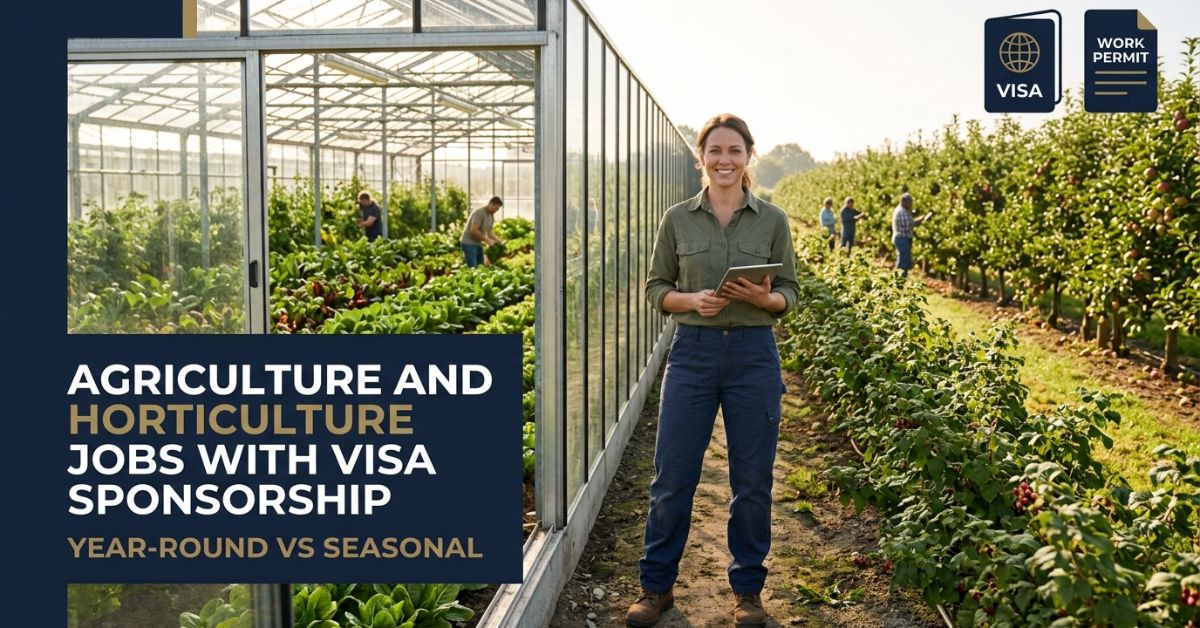
Agriculture And Horticulture Jobs With Visa Sponsorship: Year-Round vs Seasonal
A farm can stay busy all year while hiring some workers for only a few months. A greenhouse may have crops growing in every season but still recruit extra people for a short production peak. For someone applying from abroad, this difference affects much more than the end date on a contract. It shapes the type of work available, the income they can plan around and the permission they may need to take the job.
That is why agriculture and horticulture jobs with visa sponsorship should never be judged by the phrase “visa sponsorship” alone. The useful questions are more specific: What will you do? How long does the employer need you? What does the written offer say? And does the proposed work permission cover that arrangement?
Quick answer: Seasonal jobs meet a temporary need, such as planting or harvesting during a defined period. Year-round jobs meet an ongoing need, such as managing crops, equipment or staff across production cycles. A business may offer both. Applicants should compare the actual contract, duties and proposed work-permit route before deciding which opportunity fits their goals.
This article follows one clearly fictional applicant as she compares two offers. Her situation is an illustration, not a real reported case. It shows how to think through the choice without assuming that every country, employer or visa program works in the same way.
Key Takeaways
- A year-round farm does not necessarily offer every worker a year-round contract.
- Seasonal work may involve full working weeks while lasting only part of the year.
- An ongoing role may offer more continuity but can require more specific experience.
- A job advertisement does not establish that an employer can sponsor a particular applicant.
- Written duties, dates, pay and the proposed immigration route matter more than broad promises.
| Point of comparison | Seasonal position | Year-round position |
|---|---|---|
| Employer’s reason for hiring | Extra help during a defined period | A continuing operational need |
| Contract length | Has an expected end point | Intended to continue beyond one production peak |
| Common tasks | Planting, picking, grading or packing during busy periods | Crop care, equipment operation, planning or supervision across cycles |
| Income planning | Budget around the stated contract period | Assess the regular pay and long-term terms |
| Main application question | Does the job and permission cover this season? | Does a suitable route cover this ongoing role? |
These are practical distinctions, not universal immigration rules. Requirements differ by destination and by the precise job offered.
An Illustrative Applicant With Two Offers
Maya has worked with vegetable crops for several years. She has planted seedlings, monitored irrigation, checked produce quality and helped organise a small team during harvest. She wants to work abroad, improve her skills and earn a dependable income.
She finds two advertisements. One is for a short fruit-harvest season. The employer needs additional workers for picking and sorting, with a clear start date and an expected finish. The other is for a greenhouse production assistant. That business grows crops throughout the year and describes the position as ongoing.
Both advertisements mention support with visa paperwork. Maya initially assumes the greenhouse job must be better because it lasts longer. Then she looks more closely. The harvest job describes its tasks and dates clearly. The greenhouse advertisement says little about its hiring process or whether it recruits applicants from abroad.
She decides to evaluate each opportunity on its own terms. A shorter, well-documented offer may be more useful than a longer-sounding offer she cannot verify. Equally, an ongoing position could suit her goals if the employer provides clear conditions and a workable route.
Lesson from this phase: The words “seasonal,” “permanent” and “sponsored” are useful clues. None replaces a written offer.
She Separates the Business From the Job
Maya’s first discovery is simple: the length of a business’s operating year is different from the length of one worker’s employment.
Consider a farm that grows several crops. Its permanent team may prepare land, maintain equipment and organise sales throughout the year. During harvest, it may need many additional workers for a limited time. The business operates continuously; the extra positions do not.
A greenhouse can work in much the same way. Crops may grow under cover across multiple seasons, yet demand for labour can rise sharply when seedlings are moved, plants are trained or produce must be packed. Some employees may be needed throughout the year, while others are hired only for those peaks.
Maya asks both employers for the expected contract period. The harvest employer gives her a start and finish date. The greenhouse employer says the position is ongoing, but Maya asks what that means in writing. Will she have regular work between production peaks? Will her tasks change as crops develop? What hours does the employer expect during quieter periods?
She also distinguishes full-time hours from year-round employment. A person can work a full week throughout a three-month contract. That makes the work full-time during those months; it does not turn the contract into a twelve-month position.
Lesson from this phase: Ask separately about hours per week and total time employed. They answer different questions.
Agriculture And Horticulture Jobs With Visa Sponsorship: What The Route Must Cover
Maya next asks each employer which work-permit or visa route it intends to use. She wants more than “we help with visas.” She needs the route’s name and enough information to check whether her proposed job fits it.
Seasonal hiring routes are generally designed around temporary labour needs. They may be suitable for a defined period of agricultural or horticultural work, depending on the country and the permitted tasks. An ongoing supervisory or production role may need a different route. Even when both jobs are on farms, they cannot automatically be treated as the same type of application.
The offer also has to match the work Maya will actually perform. If she is recruited to pick fruit but arrives to find that most of her duties involve an unrelated job, she may face problems beyond an inaccurate job description. Likewise, an employer should not describe a continuing position as a short seasonal vacancy without explaining how the proposed arrangement works.
Nationality, experience, qualifications and the employer’s own eligibility can also affect an application. A route that suits one applicant may not be available to another. Maya therefore checks the relevant destination country’s current official requirements once she knows the exact route proposed.
She records five details for each opportunity:
- The official name of the proposed visa or work permit.
- The organisation responsible for hiring or sponsorship.
- The duties that will appear in her contract.
- The proposed start and end dates.
- What she must provide before an application can proceed.
If an employer cannot yet confirm every detail, Maya asks when it expects to do so. A recruitment process may take time. An indefinite promise with no identifiable route gives her too little to rely on.
Lesson from this phase: A job and its proposed immigration permission need to describe the same work and period.
She Examines The Seasonal Harvest Offer
The harvest employer sends Maya a draft offer. It identifies the farm, work location, crop, expected dates and method of payment. The tasks are mainly picking, grading and packing fruit during the busy period.
Maya likes the clarity. She can see why extra workers are needed and approximately when the assignment will finish. She can also plan around the end date. Rather than assuming that the farm will keep her afterward, she treats the written period as the job she is being offered.
She asks how working hours will be recorded and whether the employer expects those hours to change during the season. She wants to know where she would live, how she would travel to the workplace and which costs she would be responsible for. A seasonal offer can look attractive until accommodation, daily transport and the journey home are considered.
The physical work matters as well. Maya has farm experience, but fruit harvesting may involve long periods standing, bending or working in changing conditions. She asks what training is provided and whether any equipment is required. She does not assume that prior vegetable-growing experience makes every harvest task familiar.
Finally, she asks what happens if the harvest ends earlier or later than expected. The employer should be able to explain the contract terms and how changes would be communicated. Maya avoids building her budget around extra weeks that have not been offered.
Lesson from this phase: A good seasonal offer makes the limited period clear enough for an applicant to plan around it.
She Tests The Year-Round Greenhouse Offer
The greenhouse position appears more closely aligned with Maya’s long-term aims. It involves regular crop care, irrigation checks, quality monitoring and helping coordinate daily work. Those duties could let her develop experience beyond a single harvest.
Still, “year-round” needs examination. Maya asks whether the position is intended to remain active across the greenhouse’s production cycles. She requests information about ordinary hours, slower periods and who supervises the role. She also asks whether she would remain at one site or move between locations.
The employer explains that its permanent team works through preparation, growing, harvesting and cleaning periods. Maya asks for those responsibilities to be reflected accurately in the job description. A broad title such as “greenhouse worker” tells her less than a clear account of what she will do each month.
She also considers whether she meets the position’s requirements. An ongoing job may involve machinery, record keeping, team coordination or crop-specific knowledge. Her CV should show relevant experience without exaggerating it. If she has supported a supervisor but never managed a team independently, she says so plainly.
Most of all, Maya asks how the employer intends to recruit her legally from abroad. A continuing job may call for a different process from a seasonal placement. Until the employer identifies the proposed route and confirms that it can use it for this position, the advertisement remains an opportunity to investigate rather than a firm plan to relocate.
Lesson from this phase: An ongoing job becomes a practical option when the employer can explain both the work and the proposed hiring route.
The Pay Comparison Is More Than An Hourly Rate
Maya lays the two offers side by side. The harvest advertisement shows a higher hourly figure. The greenhouse offer suggests steadier employment. Neither headline tells her what she could actually save.
For the harvest job, she considers the number of weeks in the written offer, expected paid hours and possible costs during and after the assignment. A short period of strong earnings could suit someone who wants a temporary opportunity. It may be less suitable for someone who needs continuous income and cannot comfortably cover a gap afterward.
For the greenhouse job, Maya examines regular pay alongside responsibilities and living costs. A longer job does not automatically leave more money available each month. Housing near the workplace, transport and the consistency of paid hours still matter.
She creates a simple comparison before choosing:
| Question | Why Maya asks it |
|---|---|
| What is the written pay rate or salary? | The advertised figure should match the actual offer. |
| How are working hours set and recorded? | Total earnings depend on paid time, not just the rate. |
| Which costs will I pay myself? | Travel, housing and daily transport affect savings. |
| Is accommodation available, and on what terms? | A nearby place to live may be valuable but must be understood. |
| What happens when the contract ends? | Maya needs a realistic plan for the next period. |
| Are extra hours or another contract guaranteed? | She should not budget around an informal possibility. |
She does not calculate future income from the busiest possible week. She starts with what the employer can put in writing and treats anything beyond that as uncertain.
Lesson from this phase: Compare the likely value of the whole offer, including its duration and costs.
How She Checks Whether Each Offer Is Genuine
Maya discovers the harvest opportunity through a recruitment page and the greenhouse opportunity through a job board. Neither source alone proves that the person contacting her represents the employer.
She checks the company’s independently located website and contact details. When an intermediary is involved, she asks for its relationship with the employer and the specific role it plays in recruitment. She keeps copies of the original advertisements so she can compare later messages with the first terms she saw.
She is particularly careful with requests for money. Application-related costs may exist, depending on the destination and route, but a payment demand should have a clear purpose that she can verify independently. Pressure to transfer money immediately, a changing explanation of what the charge covers or refusal to provide written job terms all give her reason to pause.
A professional-looking document is not enough on its own. Names and logos can be copied. Maya confirms details through channels she finds herself rather than replying only to the number or address printed on the offer letter.
Her checks do not make every uncertainty disappear. They do, however, give her a sensible basis for deciding whether to proceed.
Lesson from this phase: Verify the employer, any recruiter and the proposed immigration process separately.
Which Job Makes Sense For Different Applicants
Maya has useful experience, so she can reasonably consider both offers. Other applicants may reach different conclusions.
A first-time agricultural worker might prefer a well-explained seasonal job with suitable training. The limited contract could provide experience without requiring them to present themselves as a skilled supervisor. They should still assess the physical demands, living conditions and total cost.
An experienced crop worker may find value in both seasonal and ongoing opportunities. Their strongest applications will describe real tasks: crops handled, tools used, quality standards followed and any responsibility for colleagues. Specific experience helps an employer see where the applicant fits.
Someone seeking stable income across the year should examine ongoing roles carefully. They should ask how the business operates between harvests and whether the position remains active during quieter periods. They also need a proposed work route that fits the job rather than assuming a seasonal placement will continue.
Someone hoping to build a management career may focus on roles involving production planning, staff coordination or technical decisions. Those applicants should show evidence of the responsibilities they have actually held. A senior-sounding title without matching experience is unlikely to help.
Someone who can work abroad only for a limited period may prefer seasonal work. A defined finish date can be an advantage when it fits personal commitments. The important point is to choose that arrangement knowingly.
There is no single best route for everyone. The stronger choice is the offer whose duties, duration, costs and legal process fit the applicant’s circumstances.
Maya’s Decision
Maya decides to continue discussing the greenhouse job because it matches her experience and her wish for ongoing work. She does not accept it immediately. First, she wants a complete written description and a clear explanation of the proposed immigration route.
She keeps the harvest offer as a separate option. It has a shorter timeline, but its defined duties and dates make it easier to assess. If the greenhouse employer cannot substantiate its hiring plan, Maya may decide that a verified seasonal contract is the more practical opportunity for now.
Her choice is not a verdict that year-round jobs are always better. Nor does it make seasonal work a stepping stone that automatically leads to permanent employment. Each offer stands on its own terms.
The most useful habit Maya develops is asking for specifics early. It saves her from spending money or making life plans around a phrase in an advertisement.
What To Confirm Before You Apply
Before sending documents or agreeing to travel, an applicant can use Maya’s questions as a final review:
- Is the job seasonal or genuinely ongoing?
- What are the written start date, duties, hours and pay?
- Who is the employer, and who is handling recruitment?
- Which visa or work-permit route is proposed?
- Does that route fit the job and the applicant’s circumstances?
- Which expenses belong to the worker?
- What happens at the end of the contract?
- Have the current requirements been checked with the destination country’s official authority?
These questions will not guarantee an offer or approval. They do make the decision clearer. For an international applicant, clarity is valuable: it separates a promising vacancy from a relocation plan that has not yet been properly explained.
Frequently Asked Questions
Can A Seasonal Farm Job Have Full-Time Hours?
Yes. A worker may be scheduled for full working weeks during a limited contract. Check both the expected weekly hours and the date when the job is due to end.
Does A Year-Round Greenhouse Offer Every Worker A Year-Round Contract?
No. The business may need permanent staff for continuing operations and additional workers during production peaks. Ask what period your particular position covers.
Are Seasonal Jobs Suitable For People Without Farm Experience?
Some employers train new workers, while others want relevant experience. The answer depends on the tasks and the offer. Applicants should assess physical demands and working conditions alongside the stated requirements.
Can A Seasonal Job Become Permanent Later?
It should not be assumed. A future job and any new work permission would need to be assessed under the rules that apply at that time. Make plans based on the contract currently offered.